OpenAI Reports AI Discoveries in Mathematics, Computer Science and Physics
OpenAI has released AI-generated research results across three fields, while inviting outside experts to scrutinize and explain the findings.
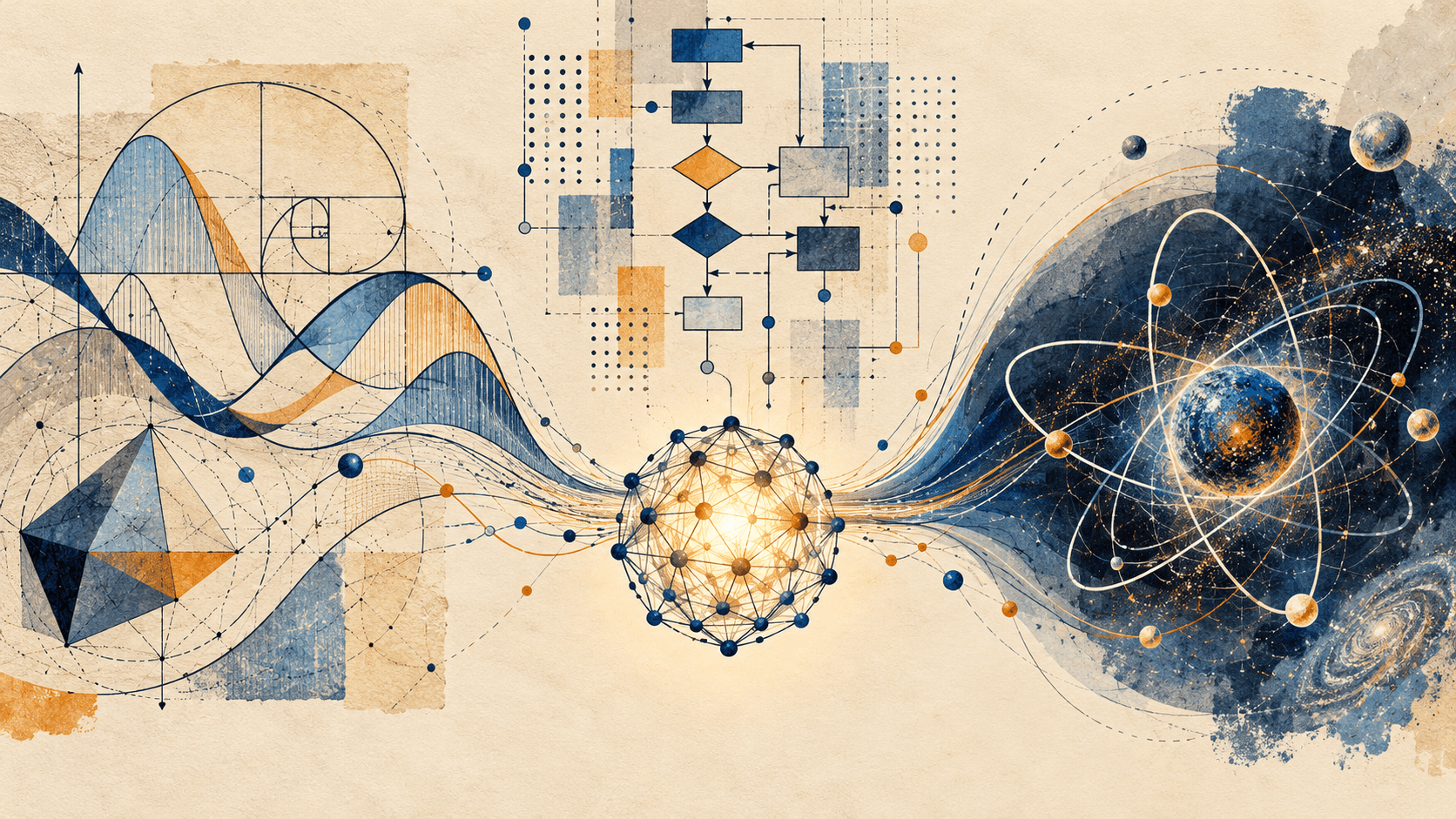
OpenAI has released AI-generated research results across three fields, while inviting outside experts to scrutinize and explain the findings.
Primary Source Verified & Fact-Checked
All claims, architectural disclosures, benchmark numbers, and policy statements cited in this dispatch are corroborated with primary documentation (official whitepapers, GitHub source weights, or Indian government gazettes).
OpenAI AI discoveries AI-generated findings in mathematics, computer science and physics. See what the claims involve and how outside researchers will review them.
OpenAI has announced research findings generated with its AI systems in mathematics, computer science and physics. The company has invited outside researchers to examine the work and explain its significance. Each field is following a different review and publication process. Read more AI news and updates on our site.
Mathematics: A Proof About Wave Behavior
The mathematics result concerns the local smoothing conjecture, a problem about how waves behave over time. OpenAI says its models produced a proof that applies in every spatial dimension. The company says the result also resolves the Kakeya and Stein restriction conjectures across dimensions.
OpenAI has made the model-generated explanation and a formalization in Lean available for researchers to study. Lean is software that helps verify whether a proof follows logically from its assumptions.
Computer Science: A Challenge to the ETH
The computer science claim concerns the Exponential Time Hypothesis (ETH), a conjecture used in research on the difficulty of solving certain Boolean satisfiability problems. OpenAI says its AI system found a way to disprove the hypothesis and that the result was formalized in Lean.
If the claim withstands expert review, researchers may need to reassess work that relies on ETH to establish limits on efficient computation. Its practical impact on algorithm design remains uncertain. Computer scientists Russell Impagliazzo, Ramamohan Paturi and Ryan Williams are leading an external group examining the result.
Physics: Review Before Publication
OpenAI also describes work on mathematical existence proofs for certain four-dimensional quantum field theories. The announcement mentions quantum chromodynamics and a unified completion of the Standard Model, as well as a result related to pure Yang–Mills theory, a longstanding problem associated with a Clay Mathematics Institute prize.
Physicist David Gross is leading the group reviewing the physics work. At the collaborators’ request, OpenAI is holding back the AI-generated materials while the group prepares its own explanation.
How the Findings Will Be Credited
OpenAI says it will not seek academic credit for the results. The external groups will be credited for the explanations and materials they produce, and will help identify relevant earlier research. The company says the researchers are participating voluntarily and invites feedback on its review process.
Important: These are findings reported by OpenAI. Their validity and wider importance depend on independent examination and further research.
Frequently Asked Questions
What fields do OpenAI’s announced findings cover?
They cover mathematics, theoretical computer science and physics.
What is the local smoothing conjecture?
It is a mathematical question about how wave behavior changes over time. OpenAI says its models produced a proof applying across spatial dimensions.
Why does the ETH claim matter?
The Exponential Time Hypothesis is used in arguments about computational complexity. If OpenAI’s claim is confirmed, researchers may revisit results that rely on the hypothesis.
Is the physics research publicly available?
OpenAI says the physics collaborators asked it to delay releasing the AI-generated materials while they prepare an explanation.
Have the findings been independently verified?
OpenAI says some results were formalized using Lean. Independent experts are reviewing the claims, and further research is needed to understand their significance.
Source: OpenAI’s announcement on working with academic communities.
About AI Latest News Editorial Team
Technology JournalistDedicated team of AI researchers, benchmark evaluators, and technology journalists in Bengaluru, Hyderabad, and Delhi.
View all dispatches by AI Latest News Editorial Team →Discussion (0)
No comments yet. Start the conversation!
Recommended Reading

ChatGPT vs Claude vs Gemini: Which Is Best in India in 2026?
We stress-tested OpenAI ChatGPT Plus, Anthropic Claude 3.5 Sonnet, and Google Gemini 1.5 Pro across Indian English, regional language reasoning, UPI coding tasks, and rupee pricing.

India to Deploy 10,000 GPUs Under National AI Mission: Tender Allocations Finalized
Government finalizes public-private partnership tenders with CtrlS, Yotta, and Tata Communications to provide sovereign compute access for domestic AI companies.